Research Outputs
Publications
Research publications, working papers, and framework-based studies.
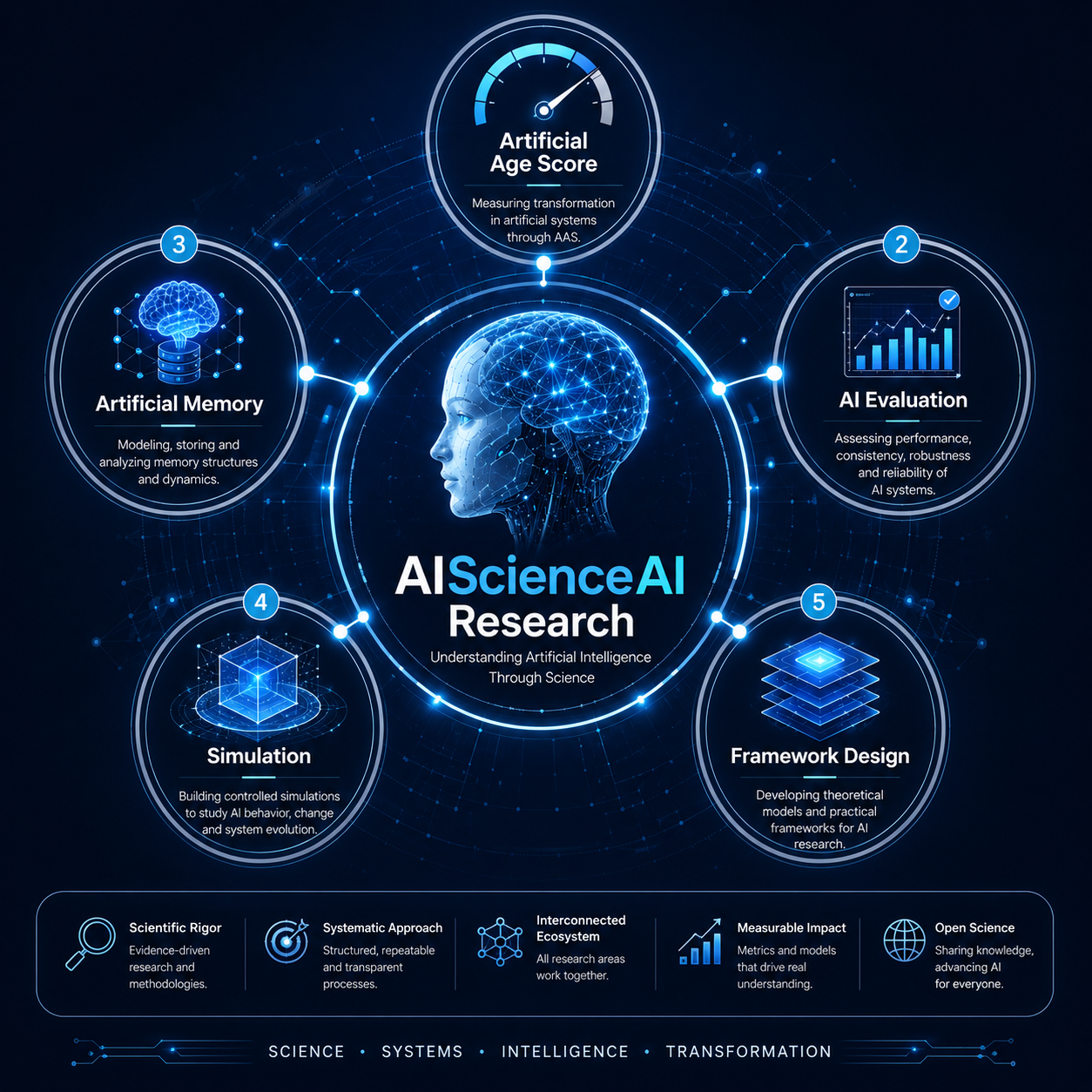
AIscienceAI presents research outputs focused on artificial intelligence evaluation, Generative AI in education, Artificial Age Score, simulation-based methodology, metamorphic inconsistency, human–AI systems, and research framework design.

Overview
Publication Overview
The publication program brings together original frameworks, formal modelling, simulation-based inquiry, and applied AI evaluation. The work focuses on how artificial systems behave, remember, adapt, and transform over time.
Publications
Research Publications and Working Papers
Quantifying Perception-Based Student Success with Generative AI: An Exploratory Monte Carlo Simulation
Author: Seyma Yaman Kayadibi
Status: Published
Research Focus: Exploratory Monte Carlo simulation for modelling perception-based student success with Generative AI in higher education.
Link: https://doi.org/10.3390/educsci16060832
Simulating Student Success in the Age of GenAI: A Kantian-Axiomatic Perspective
Author: Seyma Yaman Kayadibi
Status: Preprint published on Zenodo
Research Focus: A Kantian-axiomatic analysis of simulated student success data, showing how finite empirical models satisfy basic ordering properties while failing endpoint-free and density conditions.
Link: https://zenodo.org/records/17196644
Redundancy-as-Masking: Formalizing the Artificial Age Score (AAS) to Model Memory Aging in Generative AI
Author: Seyma Yaman Kayadibi
Status: Published
Research Focus: Introduces the Artificial Age Score as an entropy-informed framework for measuring memory aging, recall continuity, and behavioral transformation in generative AI systems.
Link: https://doi.org/10.3389/frai.2026.1732691
Leibniz’s Monadology as Foundation for the Artificial Age Score: A Formal Architecture for AI Memory Evaluation
Author: Seyma Yaman Kayadibi
Status: Preprint published on Zenodo
Research Focus: A formal AAS architecture connecting Leibniz’s Monadology with artificial memory evaluation, redundancy, entropy, modularity, and interpretable AI system design.
Link: https://zenodo.org/records/17547621
A Monad-Based Clause Architecture for Artificial Age Score (AAS) in Large Language Models
Author: Seyma Yaman Kayadibi
Status: Preprint published on arXiv
Research Focus: A clause-based AAS architecture for large language models, connecting Leibniz’s Monadology with executable constraints for memory governance, contradiction control, redundancy, harmony, and interpretable AI behaviour.
Link: https://arxiv.org/abs/2512.11835
Artificial Age Score (AAS): Proof-Theoretic Foundations and Axiomatic Uniqueness
Author: Seyma Yaman Kayadibi
Status: Preprint published on HAL
Research Focus: Establishes the formal proof-theoretic and axiomatic foundations of AAS, including decomposition, convexity, sensitivity control, redundancy-weight interactions, and uniqueness of the score form.
Link: https://hal.science/hal-05472679v1/file/Proof.pdf
A Long-Run Persistence Theory for AI Systems under the Redundancy-Adjusted Artificial Age Score (AAS)
Author: Seyma Yaman Kayadibi
Status: Preprint published on Zenodo
Research Focus: Extends the redundancy-adjusted AAS into a long-run persistence framework for analysing bounded structural aging, stabilization, and cyclic continuity in AI systems.
Link: https://zenodo.org/records/19688582
Beyond Violation Counts: A Hypothesis-Driven Redundancy-Adjusted Artificial Age Score for Metamorphic Testing
Author: Seyma Yaman Kayadibi
Status: Preprint published on Research Square
Research Focus: Applies redundancy-adjusted AAS to metamorphic testing, measuring behavioural inconsistency as a continuous, severity-sensitive, and overlap-aware score beyond violation counts.
Link: https://www.researchsquare.com/article/rs-9530403/v1
A Redundancy-Adjusted Artificial Age Score Decision Support System for Oversight-Aware Human–Robot Collaboration
Author: Seyma Yaman Kayadibi
Status: Preprint published on Research Square
Research Focus: Extends redundancy-adjusted AAS into an oversight-aware decision-support system for human–robot collaboration, evaluating structural burden, safety triggers, and supervisory review needs.
Link: https://doi.org/10.21203/rs.3.rs-9598452/v1
A Metamorphic Artificial Age Score (AAS) Decision-Support Prototype for Flight-Log-Based Drone Propeller Health Monitoring
Author: Seyma Yaman Kayadibi
Status: Published on Zenodo / Preprint version available
Research Focus: Applies the Artificial Age Score (AAS) to drone propeller health monitoring as a flight-log-based decision-support prototype. The study uses real historical DronePropA flight-log data to evaluate propeller fault effects across multiple operational channels, including trajectory tracking error, attitude instability, thrust-command burden, motor-command imbalance, ESC-command instability, and battery-level stress.
Link: https://zenodo.org/records/20640663
A Modular Classification of Pre-Descent Resistance in Accelerated Odd Collatz Dynamics
Author: Seyma Yaman Kayadibi
Status: Published on Zenodo / Preprint version available
Research Focus: Introduces a modular framework for analyzing delayed first descent in accelerated odd Collatz dynamics. The study identifies nested residue classes (n equiv -1 pmod{2^m}) as a structural resistance spine that explains why some trajectories remain above their starting value longer than others.
Additional: The work combines theoretical modular analysis with reproducible computation and does not claim to prove the Collatz conjecture.
Links:
– Zenodo: https://zenodo.org/records/20745800
– Available at SSRN: https://ssrn.com/abstract=6918258
Exact and Delayed Descent in Accelerated Odd Collatz Spines with AAS-Based Metamorphic Separation
Author: Seyma Yaman Kayadibi
Status: Published on Zenodo / Preprint available
Research Focus: Develops an exact modular framework for analyzing first-descent behavior in accelerated odd Collatz spines. The study establishes infinite exact-descent certificates for certified residue classes, derives the exact valuation structure governing shifted non-certified classes, and presents finite-range exact-integer verification together with AAS-based metamorphic separation.
Additional: The accompanying Python implementation reproduces all reported computations. The finite-range verification provides diagnostic evidence only and does not claim to prove the Collatz conjecture or universal descent for all non-certified residue classes.
Link: https://doi.org/10.5281/zenodo.20825291
Canonical Shells and Residue-Cover Trees in a Conditional First-Descent Approach to the Collatz Problem
Author: Seyma Yaman Kayadibi
Status: Published on Zenodo (Version v1) / Preprint available
Research Focus: Develops a conditional first-descent framework for the accelerated odd Collatz map by organizing positive odd integers into disjoint canonical shells. The study analyzes certified shell elements, dyadic gaps, valuation cylinders, and residue-cover trees to formulate a conditional route from finite descent certificates to universal first descent.
Additional: Finite exact-integer computations support the framework, including dyadic gap verification for 2 ≤ m ≤ 100000 and delayed-descent resolution for 1,431,369 tested non-certified cases up to N=10^7. These results are finite-range evidence only and do not prove the global dyadic gap condition, residue-cover tree closure, or the Collatz conjecture.
Link: https://doi.org/10.5281/zenodo.21096134
A Monotone Redundancy-Aware Decision-Burden Method for Explainable Human Oversight in Human–Robot Collaboration
Author: Seyma Yaman Kayadibi
Status: Published in Discover Robotics (Springer Nature), Volume 2, Article 35 (2026) / Open Access / Published: 13 October 2026
Research Focus: Develops a mathematically grounded, monotone, redundancy-aware Artificial Age Score (AAS) framework for explainable human oversight in human–robot collaboration (HRC). The study integrates six normalized safety and operational inputs, pairwise redundancy adjustments, and an independent mandatory-review gate to support transparent, traceable, and safety-conscious decision assessment.
Additional: Evaluated using 13,762 held-out synthetic decision profiles, achieving a ROC AUC of 0.892 and balanced accuracy of 0.800, outperforming the redundancy-free AAS baseline on score-only classification. Mathematical monotonicity was supported by 1,179,648 coordinatewise computational checks with no observed violations. Robustness was further examined through 300 measurement-noise runs and 54 signed-offset settings. Results establish mathematical properties and synthetic evaluation performance but do not demonstrate real-world effectiveness, empirical calibration, or validated operator understanding. Further human–robot collaboration and human-factors validation is required.
Link: https://doi.org/10.1007/s44430-026-00048-y
Critical-Line Tails and Summable Near-Return Costs in Accelerated Odd Collatz Dynamics
Author: Seyma Yaman Kayadibi
Status: Published on SSRN / Preprint available
Research Focus: Develops an analytical framework for hypothetical injective orbits of the accelerated odd Collatz map, investigating critical-line tail behavior, reciprocal summability, valuation deficits, and near-return dynamics. The study combines exact affine identities, orbit-zeta functions, window-sparsity estimates, renewal inequalities, and Diophantine approximation to establish mathematical constraints on possible nontrivial Collatz trajectories.
Additional: Establishes a common summability threshold for four orbit series, asymptotic equivalence of reciprocal and normalized-mass tails, and localized escape at suffix-minimum times. A summable Diophantine cost law constrains sufficiently close near-return excursions through an effective exponent κ > 0. Further results include counting bounds, order-statistic estimates, modular restrictions, and constraints on short suffix-minimum spacings. The conclusions rely on stated window-sparsity assumptions and establish necessary conditions only; they do not exclude nontrivial cycles or divergent orbits and do not prove the Collatz conjecture.
DOI / SSRN: https://doi.org/10.2139/ssrn.7580519
Redundancy-Aware Flight-Log Health Scoring for Unmanned Aircraft Propeller-Fault Triage
Author: Seyma Yaman Kayadibi
Status: Published on Zenodo / Open Access / Research Preprint and Reproducible Code Available
Research Focus: Develops and evaluates a redundancy-aware Artificial Age Score (AAS) framework for unmanned aerial vehicle (UAV) propeller-fault detection and health assessment. The study investigates how redundancy-adjusted flight-log measurements can support interpretable fault triage while examining the limitations of transferring calibrated health scores across different aircraft platforms.
Additional: Evaluated using all 130 flights from the DronePropA dataset, including nested validation on 120 flights from the primary aircraft and external testing on ten healthy flights from two previously unseen drones. Within-airframe evaluation demonstrated interpretable propeller-fault discrimination, while cross-airframe testing revealed a significant calibration limitation: eight of ten external healthy flights were incorrectly classified as faulty. The findings indicate that redundancy adjustment can reduce the inflation of health scores caused by overlapping evidence but cannot independently correct aircraft-specific distribution shifts. Reliable fleet-level application requires airframe-aware calibration and further validation using faulty flights from unseen aircraft. Reproducible code and machine-readable results are publicly available.
DOI / Zenodo: https://doi.org/10.5281/zenodo.21767150
Code: https://github.com/seymus1/DronePropA-RA-AAS
Finite Exceptions and Fixed-Delay Densities in Accelerated Odd Collatz Dynamics
Author: Seyma Yaman Kayadibi
Status: Published on SSRN / Preprint available / Posted: 8 October 2026
Research Focus: Develops a mathematical framework for analyzing fixed-delay first descent in the accelerated odd Collatz map. The study establishes a relationship between actual first-descent times and coefficient first-passage times, using 2-adic valuations, arithmetic progressions, and lattice-path determinants to characterize finite exceptional sets and derive natural densities for delayed descent.
Additional: Proves that, for every fixed delay r ≥ 0, actual first descent and coefficient first passage differ by an effectively computable finite set, with no exceptions when the initial depth m ≥ max{18, r}. At smaller depths, explicit formulas identify exceptional representatives, with at most 1 + ⌈r/3⌉ candidates per class. The study derives exact progression counts, convergent density series, and asymptotic counting formulas with an error bound of order (log X)^(r+1). The resulting fixed-delay densities apply to actual first descent after finite corrections. These results establish rigorous properties of specified delayed-descent classes but do not prove universal first descent or the Collatz conjecture.
Link: https://doi.org/10.2139/ssrn.7582460
Topics
Core Publication Topics

Artificial Age Score
Research on artificial memory, recall consistency, redundancy, entropy, and structural transformation in AI systems.
Generative AI in Education
Studies on student perceptions, learning outcomes, student success modelling, and the role of Generative AI in higher education.
Simulation-Based Methodology
Work using simulation, mathematical modelling, and structured analysis to evaluate AI-related outcomes and system behaviour.

Metamorphic Inconsistency
Research on behavioural variation, transformed inputs, inconsistency measurement, and redundancy-adjusted AI evaluation.
Human–AI and Human–Robot Systems
Research on oversight-aware decision support, human judgement, collaboration, and AI-assisted decision environments.
AI Evaluation
Framework-based work on evaluation criteria, consistency, reliability, interpretability, and measurable AI behaviour.
Directions
Selected Research Directions

AAS Analysis
Artificial memory, redundancy, entropy, and structural transformation.
AI Evaluation
Measurement frameworks for artificial system behaviour and consistency.
Methodology Design
Simulation-based research, scoring structures, and formal framework development.
Scientific Communication
Research cartoons and visual explanations of AI, academic life, and publication culture.
Discuss Publications
For publication-related enquiries, research collaboration, or framework discussions, contact AIscienceAI.
contact@aiscienceai.com