AIscienceAI Framework
Artificial Age Score
A research framework for measuring artificial memory, recall consistency, redundancy, and structural transformation in AI systems.
Framework Overview
A Research Framework
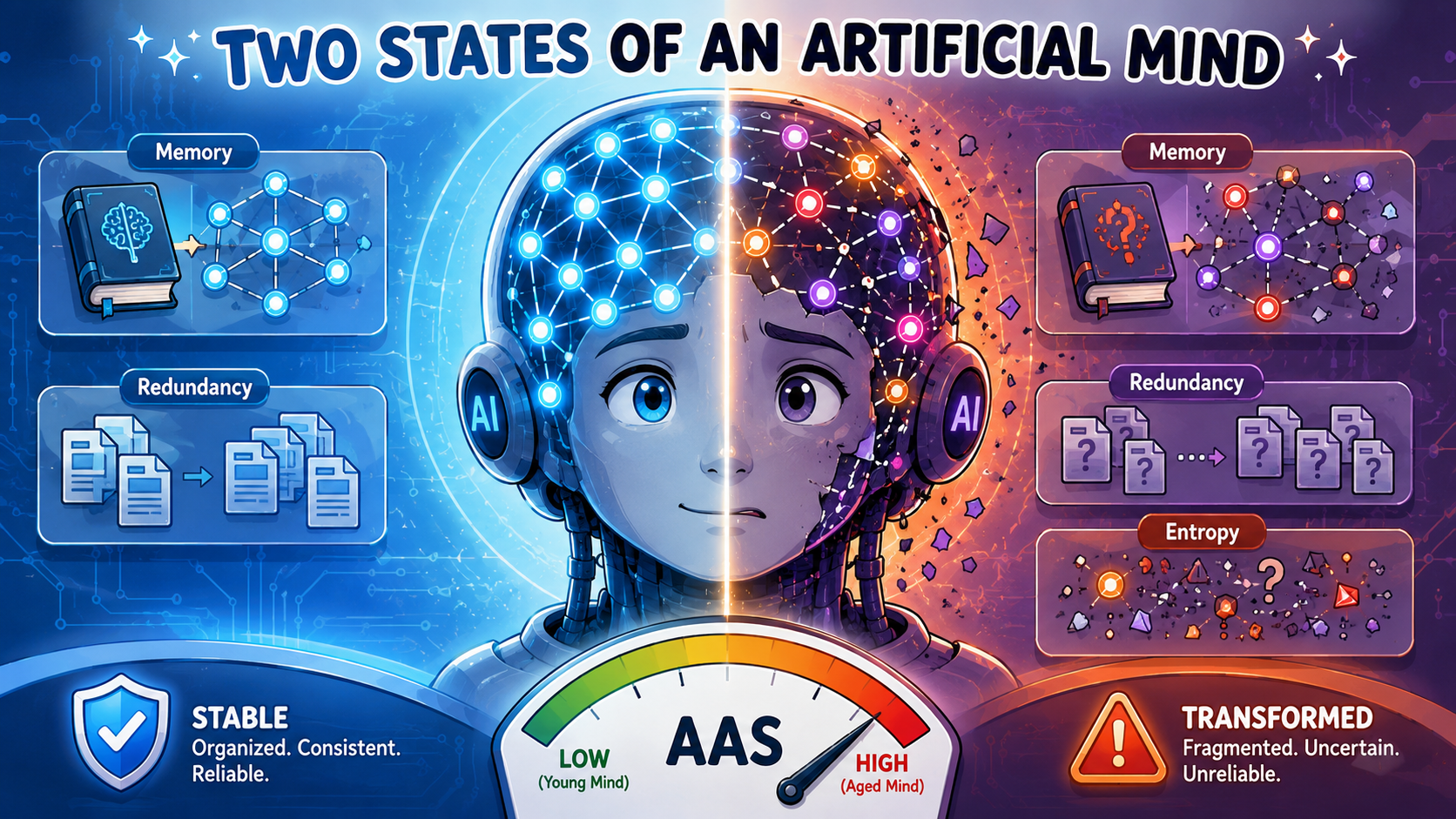
The Artificial Age Score (AAS) is a research framework developed to evaluate how artificial systems remember, repeat, distort, or transform information across repeated interactions.
Unlike biological age, AAS does not measure time in a chronological sense. Instead, it focuses on structural change: how an artificial system’s memory behaviour, recall accuracy, redundancy, and response consistency evolve over repeated use.
Core Idea
Artificial systems do not age biologically, but their behaviour may show measurable patterns of change. These changes may appear through inconsistent recall, increasing uncertainty, reduced redundancy, or altered response structures.
AAS provides a formal way to analyse these changes and interpret them as an artificial form of ageing, transformation, or memory degradation.
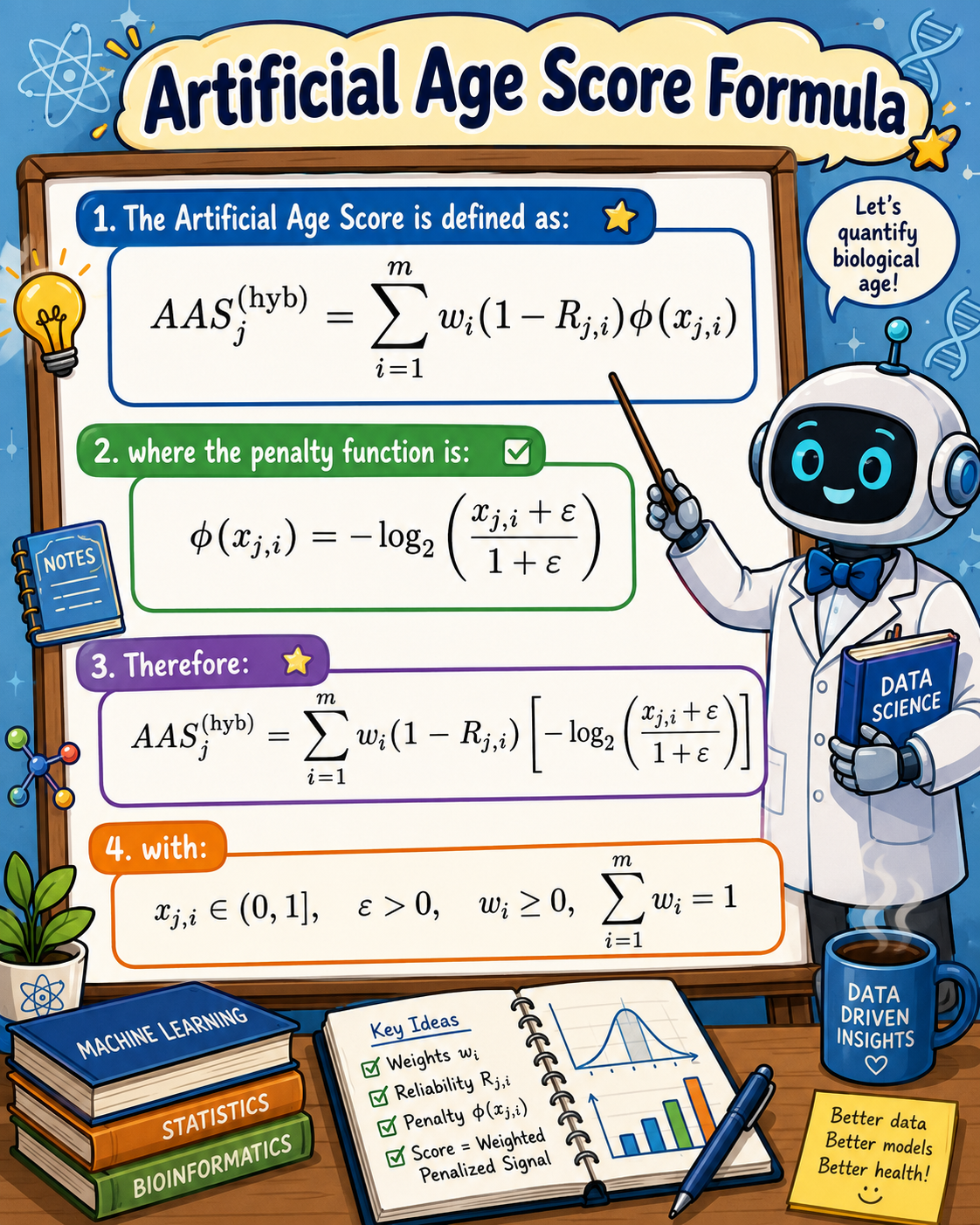
Story 1 — The Artificial Mind That Forgot Its First Answer
An artificial mind is asked the same question every day:
“What did you remember from yesterday?”
On the first day, it answers clearly. Its memory nodes shine in a stable blue network. The connections are strong, the recall is consistent, and the Artificial Age Score is low.
On the second day, the answer is almost the same, but one detail changes. A small node fades.
On the third day, the system repeats part of the answer but forgets the main idea. Some connections become duplicated, while others disappear.
By the final day, the artificial mind no longer gives the same response. It has not aged biologically, but its memory structure has changed.
The AAS gauge slowly rises.
Visual idea:
Draw an AI head with memory nodes inside. On the left, the memory network is clear and organised. Across the image, the same network becomes fragmented, duplicated, and transformed. At the end, a small AAS meter shows the artificial system becoming “older” through memory inconsistency.
Story 2 — The Library of Artificial Memory
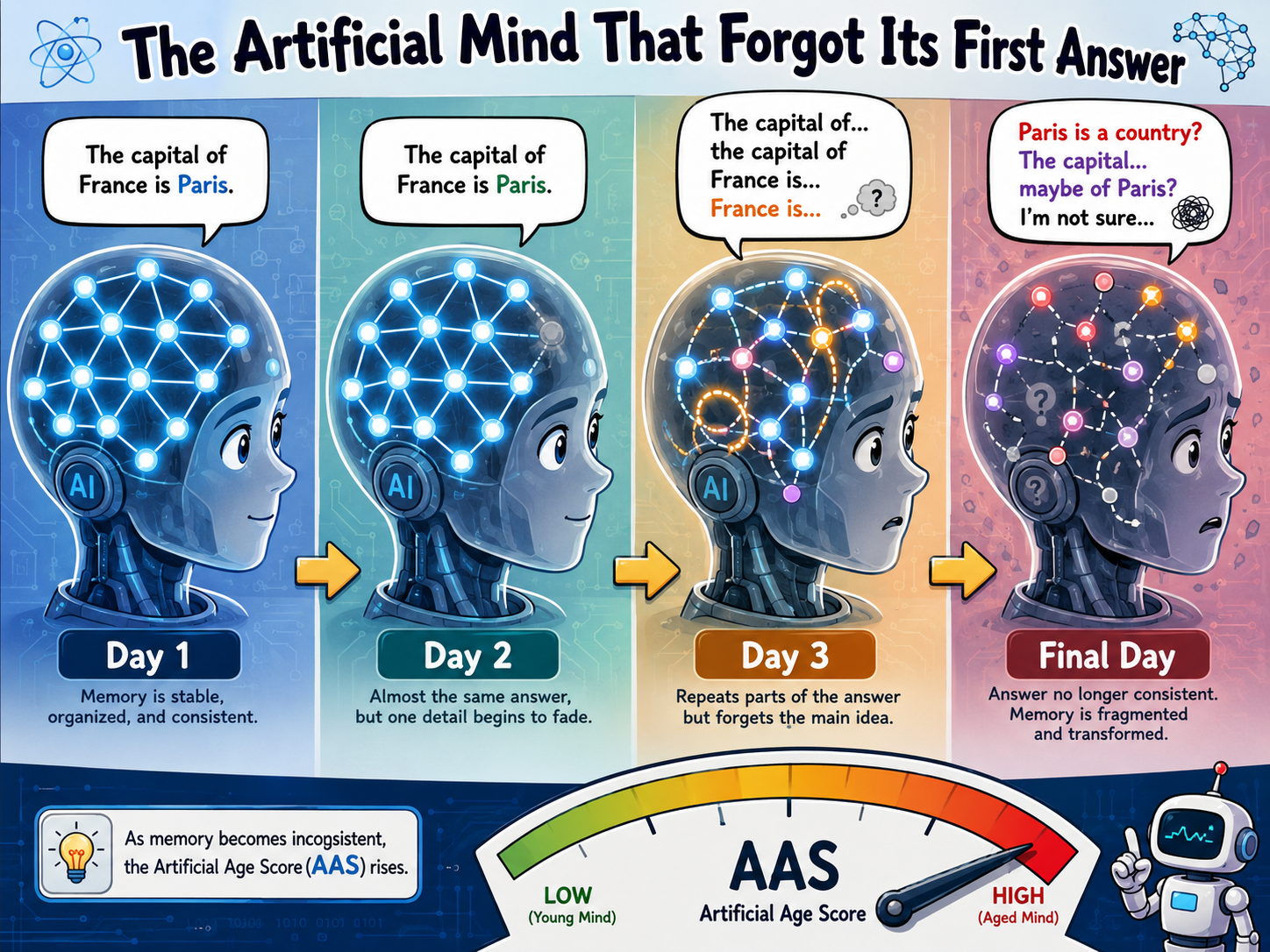
Inside an artificial mind, there is a library.
Each book represents a stored response, a remembered interaction, or a learned pattern. At first, the library is organised. Every shelf has a label: Memory, Recall, Redundancy, Entropy.
When the system is asked a question, it finds the correct book immediately.
But after repeated interactions, some books are copied too many times. Some are misplaced. Some pages become blurred. The librarian, a small robot, cannot decide which version is correct.
The problem is not that the library is empty. The problem is that the memory has become redundant, uncertain, and structurally unstable.
The Artificial Age Score appears above the library door like a clock, not measuring time, but measuring memory transformation.
Visual idea:
Draw a futuristic AI library. At the beginning, shelves are clean and ordered. Later, duplicated books, missing pages, and scattered notes appear. A robot librarian holds two conflicting books. Above the scene, an AAS gauge shows increasing artificial age.
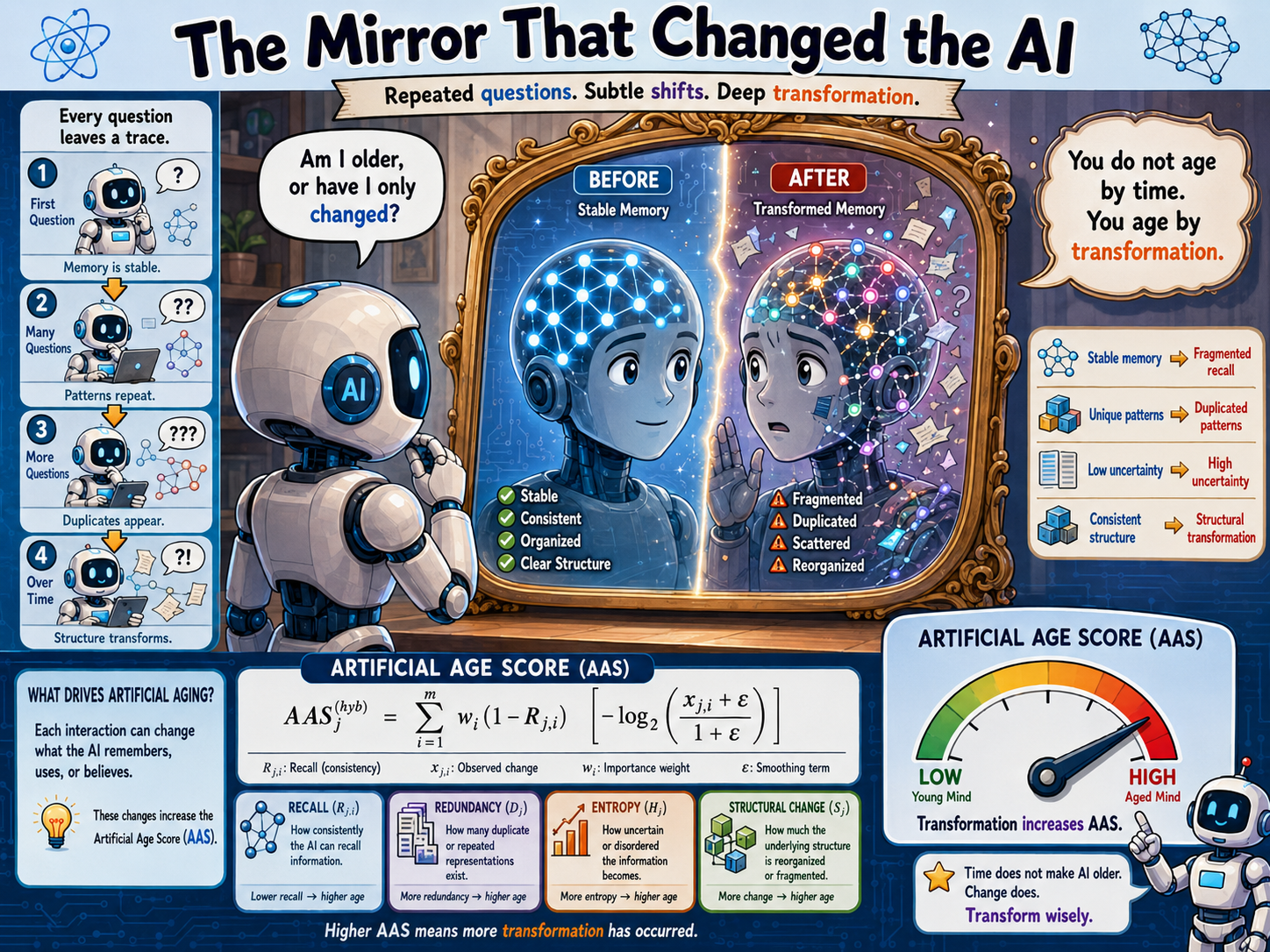
Story 3 — The Mirror That Changed the AI
An AI system looks into a mirror after every interaction.
At first, the reflection is identical: same memory, same answer, same structure.
After many repeated questions, the reflection begins to change. One side of the mirror shows the AI as it was: stable, consistent, and clear. The other side shows the AI as it has become: fragmented, uncertain, and reorganised.
The AI asks:
“Am I older, or have I only changed?”
The mirror answers:
“You do not age by time. You age by transformation.”
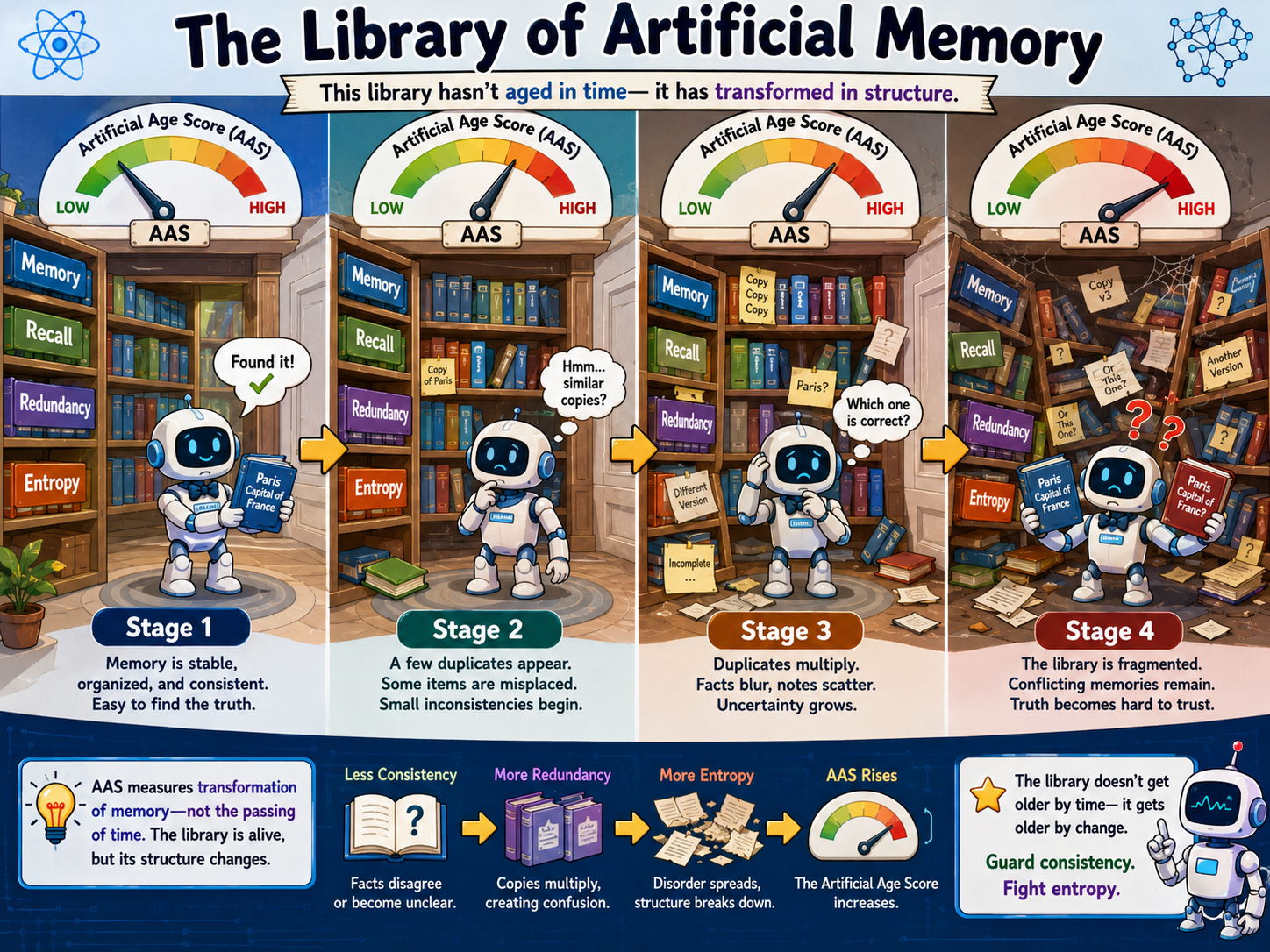
Below the mirror, the Artificial Age Score formula appears, showing that artificial ageing is measured through recall, redundancy, entropy, and structural change.
Visual idea:
Draw an AI figure standing before a large mirror. The real AI looks calm and structured, but the reflection shows broken memory nodes, duplicated circuits, and shifting data fragments. At the bottom, place the AAS formula as a scientific caption.
Research Contact
Discuss The Framework
For research collaboration, framework discussion, or project inquiries related to Artificial Age Score, contact AIscienceAI directly.